As an Amazon Associate we earn from qualifying purchases. Links marked ↗ go to Amazon UK searches; buying through them costs you nothing extra. How this site is funded.
Home Emergency Kit is an independent guide. It is not affiliated with, or endorsed by, the UK government or the Be Ready campaign.
Run by IIB Trading Ltd · hello@homeemergencykit.co.uk
Work out your household's supplies
Search Amazon UK: Bottled water Water containers Ring-pull tins
Common results at a glance
| Household | Days | Drinking water | 2-litre bottles | Food (person-days) |
|---|---|---|---|---|
| 1 adult | 3 | 9 L | 5 | 3 |
| 2 adults | 3 | 18 L | 9 | 6 |
| 2 adults, 1 child | 3 | 27 L | 14 | 9 |
| 2 adults, 2 children | 3 | 36 L | 18 | 12 |
| 2 adults, 1 baby | 3 | 27 L | 14 | 9 |
| 2 adults, 3 children | 3 | 45 L | 23 | 15 |
| 4 adults | 3 | 36 L | 18 | 12 |
| 2 adults, 2 children, 7 days | 7 | 84 L | 42 | 28 |
Each baby and child counts as one person, the same as an adult, because the checklist gives a single figure per person. Add water for pets on top, and more for cooking and washing.
How it's calculated
- People = adults + children + babies.
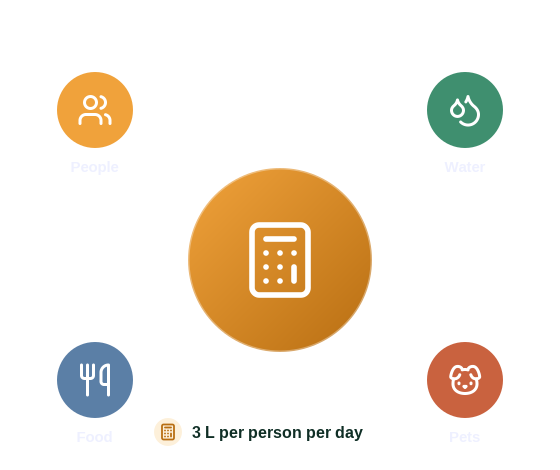
- Drinking water = people × 3 litres × days. The 3 litres per person per day comes from the Be Ready checklist (“3 litres per person per day for drinking”).
- Cooking and washing water = people × your estimate × days. The checklist says “more would be needed for other tasks such as cooking and washing” but gives no amount, so this is 0 unless you enter a figure.
- Total water = drinking + cooking and washing; 2-litre bottles = total ÷ 2, rounded up.
- Food = people × days, shown as person-days of food that needs no fridge or cooking. The 3-meals-a-day figure is an example to help you picture it, not an official number.
- Days start at 3, because Be Ready says being ready for 3 days helps you manage while support reaches those most in need. You can choose up to 14.
Inputs, assumptions and what's not included
- Inputs: adults (0 to 20), children (0 to 20), babies under 1 (0 to 10), dogs and cats (0 to 10 each), days (1 to 14) and optional extra water (0 to 20 litres per person per day).
- Assumption: everyone counts as one person at 3 litres a day. The checklist doesn't give a lower figure for children or babies. A baby fed on ready-to-feed formula won't drink this, so their share is a margin.
- Not included: water for pets (the checklist asks for pet food and bottled water but gives no amount, and we haven't found a UK vet or RSPCA figure, so ask your vet if unsure), water for medical equipment, and any cooking or washing water unless you add it.
- Babies: the calculator reminds you about ready-to-feed formula, nappies and wipes but doesn't give quantities, because babies' needs vary. If you have to use bottled water for powdered formula, follow the government guidance on preparing formula during water supply disruptions.
Our home page lists every item on the Be Ready checklist with notes on what to look for.
Share or cite a result
The calculator reads its inputs from the web address, so a link reproduces the same answer. Parameters: adults, children, babies, dogs, cats, days and extra (litres per person per day for cooking and washing). For example, /emergency-supplies-calculator?adults=2&children=2&dogs=1&days=3 shows 36 litres of drinking water for 2 adults and 2 children for 3 days, with a reminder to add food and water for the dog.
Questions people ask
How much water do I need for 3 days in an emergency?
Be Ready says 3 litres per person per day for drinking, so 9 litres per person for 3 days. A household of 4 needs 36 litres, plus more for cooking and washing.
Does the 3 litres include water for cooking and washing?
No. The checklist says 3 litres per person per day is for drinking, and more would be needed for cooking and washing. It doesn't give an amount, so the calculator lets you add your own.
Do children need less water than adults?
The Be Ready checklist gives one figure, 3 litres per person per day, and doesn't set a lower amount for children, so the calculator counts everyone the same.
How much water should I store for my dog or cat?
The checklist asks for pet food and bottled water but gives no amount. Include water for pets on top of the household total, and ask your vet if you're unsure.
How much food do I need for an emergency kit?
Enough non-perishable food for everyone for 3 days, that needs no fridge or cooking. The calculator shows it as person-days: people multiplied by days.
Can I share a result?
Yes. The web address updates as you change the inputs, for example ?adults=2&children=2&days=3, so anyone opening the link sees the same result.
Related guides
Sources
- Be Ready: Be ready for emergencies (UK government campaign)
- Be Ready checklist (PDF, October 2026)
- GOV.UK: Preparing infant formula safely during water supply disruptions
- NHS: How to make up baby formula
Official pages last checked on 23 November 2026. If anything here differs from the official advice, follow the official advice, and please tell us so we can fix it.